New pterosaur tracks discovered in S. Korea hint flying reptiles foraged on land
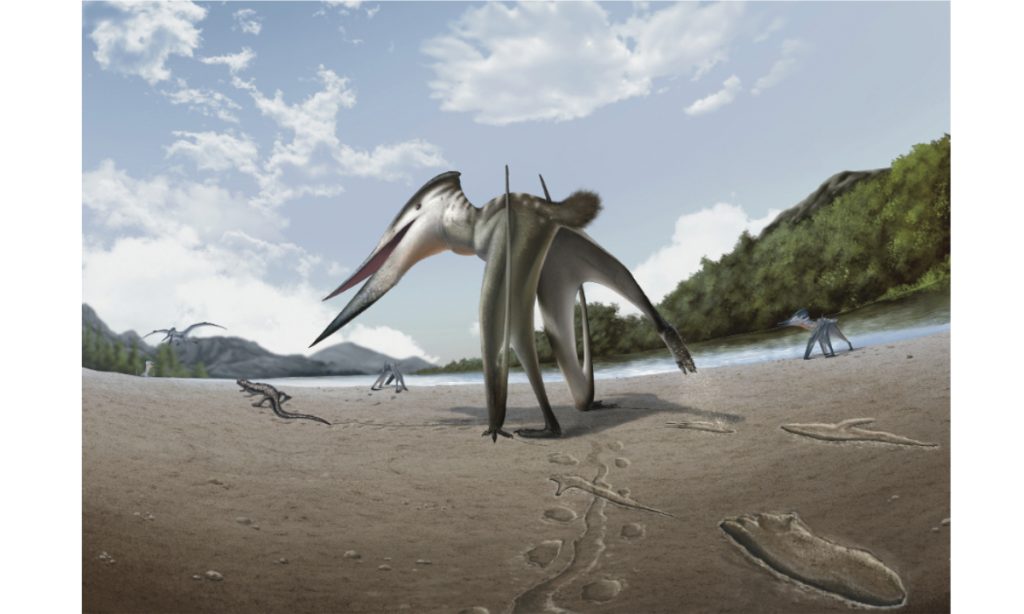
A joint study by Chinese, South Korean and US scientists has reconstructed a brief prehistoric encounter between a large pterosaur and a small animal by studying the pterosaur tracks preserved on a fossil unearthed in Jinju, South Korea. It suggests that these pterosaurs were capable of hunting on land in addition to flying.
The research team has named the pterosaur track fossil as Jinjuichnus procerus and their findings have been published in Scientific Reports, the multidisciplinary open-access journal from Nature Portfolio.
Pterosaurs were flying reptiles distinct from dinosaurs, with some species highly adapted to terrestrial life. Researchers said that the newly discovered tracks were very likely to belong to a neoazhdarchian pterosaur.
The fossil was discovered during a fossil survey conducted in Jinju Innovation City in South Gyeongsang Province in 2010. It comes from Cretaceous strata dating back about 106 million years ago, and is currently housed at the Jinju Pterosaur Tracks Museum.
What makes this fossil distinctive is that it shows a small animal's trackway beside that of the pterosaur. The small animal's trackway shows a sudden turn and longer strides, which suggests it reacted to the pterosaur's presence.
Researchers emphasized that this finding is not direct evidence of the pterosaur's predation, but it may record a brief encounter between a predator and potential prey.
The findings have further highlighted the scientific value of the Jinju fossil site. The Jinju Formation has yielded a large and diverse range of fossil tracks. In excavations conducted in the Jinju Innovation City area alone, researchers have found about 2,500 pterosaur footprints.
Unlike skeletal fossils, trace fossils record the activity of creatures rather than just their physical structure, offering unique insights into how creatures lived and moved.
The research team led by Xing Lida, a dinosaur expert and associate professor at the China University of Geosciences in Beijing, was deeply involved in this study. His team's work on tetrapod tracks and microbially induced sedimentary structures (MISS) played an important role in shaping the study.
According to Xing, his team identified MISS in the fossil, which are thought to have played a key role in preserving the vertebrate tracks. The MISS form a thin film that helps retain fine morphological details - one reason why both the pterosaur tracks and the small "prey" animal trackways in this study are so exceptionally well preserved, Xing told the Global Times on Thursday.
Alternative explanations of the fossil trackways remain possible and that footprints alone cannot confirm predatory behaviors by pterosaurs, according to researchers.