Exclusive: Ex-chief of China’s statistics bureau says he has confidence in achieving 5% GDP growth target in 2024
Ning Jizhe, a member of the standing committee of the 14th National Committee of the Chinese People's Political Consultative Conference (CPPCC) and the former chief of the National Bureau of Statistics, expressed his confidence in China achieving the GDP growth target of about 5 percent this year, while dismissing hype about the Chinese economy entering a recession.

Ning, who is also the deputy director of the Economic Affairs Committee of the CPPCC National Committee, made the remarks in an exclusive interview with the Global Times on Wednesday.

China has set its 2024 GDP growth target at about 5 percent, according to the Government Work Report submitted on Tuesday to the national legislature for deliberation.

Setting a goal of achieving around 5 percent GDP growth requires a proactive approach as it will involve hard work, overcoming obstacles and challenges. However, with determination and perseverance, this goal can be successfully achieved, Ning said.

Ning said that his confidence comes from China's huge market, complete industrial system and push for technological innovation. The unstoppable trend of globalization and the new wave of technological revolution also offer favorable conditions for China's development.

Ning noted that an economic growth target of around 5 percent effectively refutes negative narratives about the Chinese economy.

The "China economic recession" theory has been circulating for decades and it resurfaces whenever China faces key development challenges. However, facts have proven that every time, China has overcome difficulties through reform, opening-up and transformation, Ning said.

Ning highlighted China's resilience in the face of past economic challenges, such as the Asian financial crisis in the late 1990s and the global financial crisis in 2008, and he expressed optimism in China's ability to navigate challenges.

"Despite the challenges, China is currently in a phase of transitioning growth drivers, changing development modes and optimizing its economic structure. I am confident that we can achieve a GDP growth target of about 5 percent this year," Ning said.

He also dismissed claims that China's economy has peaked. "This is not only an unscientific judgment, but also a malicious attempt to discredit China. Among those who hold this view, some are ignorant of the situation," Ning said.

Ning emphasized that although China's per capita GDP reached about $12,700 in 2023, it is still the world's largest developing country, with significant room for development and potential for further growth.

The GDP growth target of about 5 percent was set based on scientific reasoning and aligns with the long-term development goals laid out in the 14th Five-Year Plan (2021-25). This is a target that can be achieved through utmost endeavor, Zheng Shanjie, head of the National Development and Reform Commission, China's top economic planner, said at a press conference on Wednesday.

The favorable conditions for China's economic development this year are stronger than the unfavorable factors, and China's economic rebound will be further consolidated and strengthened, Zheng said.

Zheng noted that China will expand macro regulation this year. Incremental policies such as large-scale equipment upgrades, trade-ins for consumer goods, and the issuance of ultra-long special-purpose treasury bonds will be implemented to support economic stability.

Positive momentum in the economy emerged in the first two months of this year, with indicators such as electricity consumption and consumer spending showing strong growth, paving the way for growth in the first quarter.

Industrial electricity usage expanded by 9.7 percent in the first two months of 2024, while the number of domestic tourist trips during the Spring Festival holidays shot up by 34.3 percent year-on-year, with a gain of 19 percent from 2019.

It's believed that imports and exports in January and February continued the growth trend that began in October last year, officials said.
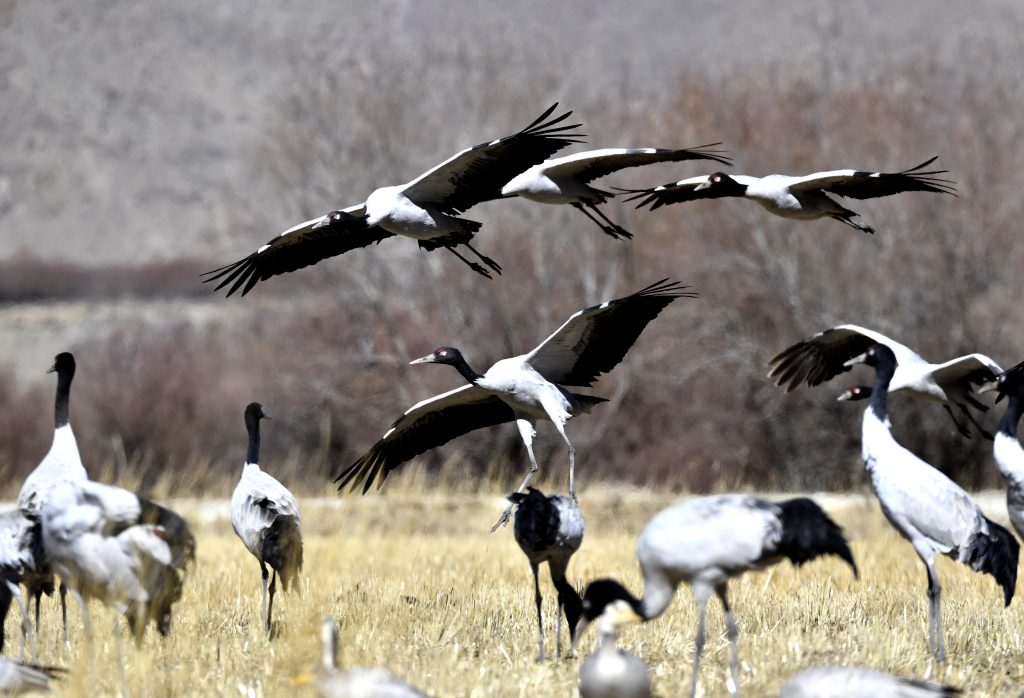

SW China’s Sichuan man under criminal detention for killing and eating national first-class protected black-necked crane

Police in Meigu county in Liangshan, Sichuan, recently received a report from the School of Ecology and Nature Conservation, Beijing Forestry University, which said that a black-necked crane with a tracker for scientific research had remained in a static status for an extended period. The institute asked for an investigation into the condition of the migratory bird. 

The police immediately formed a task force to investigate into the incident in the outskirts of a sparsely populated hamlet. 

After extensive investigations and visits, the police finally tracked down the suspect surnamed Jike. 

Jike confessed under interrogation that he illegally captured and killed the rare species of the endangered wildlife animal black-necked crane. 

According to Jike, he happened to see the big bird resting on the river bank on his way home and the idea of catching and eating the bid just occurred to him. A thought that he soon followed up on.  

According to the judicial appraisal results by a forestry judicial appraisal center in Sichuan, the bird killed by the suspect was a black-necked crane, which is one of China’s national first-class key protected animals. The tracking device tied to the bird’s foot and the serial number show that the black-necked crane was exactly the one that was used for ecological study of migration of the crane by the college institute. 

Jike has been placed under criminal detention by the police for the suspicion of the crime of endangering precious and endangered wildlife animal. The case is currently under further investigation. 

According to media reports, the black-necked crane is the only species of crane endemic to China and is among the 15 crane species that currently exist in the world. It is also the only crane species in the world that grows and breeds on plateaus, earning it the titles of “plateau fairy” and “plateau divine bird.”

China’s top legislature passed regulation on February 24, 2020 to strictly ban the illegal wildlife trade and eliminate bad habits of eating wild animals in China to safeguard people’s health and livelihoods. 

According to China’s Criminal Law, anyone who illegally captures, kills, transports, purchases or sells national protected, precious, endangered wildlife and their products, shall be sentenced to imprisonment for up to five years or faced with criminal detention, along with a fine. 

In cases of serious circumstances, the punishment may be extended to 5-10 years of imprisonment, along with a fine. In particularly severe cases, the sentence may be more than 10 years of imprisonment, along with a fine or confiscation of property and assets. 

Beijing subway carriages’ separation caused by rear-end collision due to snowy weather: transportation authority

Preliminary investigation shows the separation of carriages accident along the Changping Line of Beijing subway on Thursday evening was due to the snowy weather, which affected the train's braking system, resulting in a rear-end collision with the front train, Beijing transportation authorities said on Friday.

Around 11:00 pm on Thursday, the personnel transfer was completed, and the on-site disposal work basically finished. A total of 515 people were sent to the hospital for examination, and 102 people were found to have suffered fractures, with no fatalities, the authorities said on Friday.

According to the authorities' announcement, the accident occurred as a result of the slippery tracks caused by the snowy weather. The preceding train had to make an emergency brake to stop. Unfortunately, the following train was situated in a downhill section, making it difficult to effectively brake due to the snowy conditions.

Beijing transportation authority apologized for the inconvenience, fright, and injuries caused to the passengers in this accident, and vowed to do a good job in carrying out post-accident work and conduct a comprehensive investigation to improve extreme weather operation and emergency response to ensure the safety of operations.

It was at 6:57 pm on Thursday, when a rear-end collision occurred in the section between Xi’erqi to Life Science Park stations of the Changping Line. The municipal government officials immediately went to the scene and set up a working group for on-site accident disposal. The relevant departments including transportation, firefighting, health, public security and emergency response responded quickly and made efforts for rescue, according to the authorities.

As of 6 am on Friday, 423 people have been discharged from hospital, 25 people are under observation, and 67 people are receiving hospital treatment, the authorities said.

On Friday, Beijing Subway apologized again over the incident, while putting in place measures to reduce inconvenience for passengers.

Currently, the Beijing municipal government has established an investigation team for the Changping Line accident, which will further investigate the cause of the accident, evaluate the emergency response, and learn lessons from the accident, effectively carrying out rectification measures.

China allocates 200 million yuan in disaster relief funds after earthquake in northwest China's Gansu

The Ministry of Finance and the Ministry of Emergency Management on Tuesday have urgently allocated 200 million yuan ($28 million) in disaster relief funds to northwest China’s Gansu and Qinghai provinces. This funding will support local earthquake relief efforts and ensure the safety of people's lives and property, minimizing the impact and losses caused by the disaster, China Media Group (CMG) reported.

China is stepping up rescue and relief efforts to ensure the safety of people's lives and property after a 6.2-magnitude earthquake shook Jishishan County in northwest China's Gansu Province at midnight Monday.

The State Council has sent a working group to the stricken regions to help guide relief work. Gansu and Qinghai provinces have organized relief support with immediate allocation of relief supplies such as camps and folding beds to impacted areas.

Relief supplies were immediately redeployed from nearby areas, with supplies gradually arriving to impacted communities, China’s National Development and Reform Commission (NDRC) told a press conference on Tuesday.

The NDRC has activated emergency response mechanism to ensure energy, electricity, and essential supplies. Efforts are being made to repair damaged power facilities and provide emergency power supply. Food and material reserves are being allocated for disaster relief, a spokesperson from the NDRC said.

The first shipment of 46,100 emergency relief supplies from central and provincial level have been dispatched to the disaster-stricken areas, including cotton tents, quilts, mattresses, folding beds, cotton shoes, and stoves, according to Gansu provincial grain and material reserve bureau. The bureau has also obtained 15 tons of flour for emergency supply in Jishishan.

The State Council's earthquake relief headquarters and the Ministry of Emergency Management have upgraded the national earthquake emergency response to Level II.

At present, the earthquake has led 105 deaths in Gansu and 11 deaths in Qinghai, with damaging basic infrastructure such as water, electricity, transportation, and communications, Xinhua News Agency reported.

Rescue and relief efforts are progressing in an orderly manner, including hazard inspections, evacuation and resettlement of residents, and repair of damaged facilities, China Media Group reported.

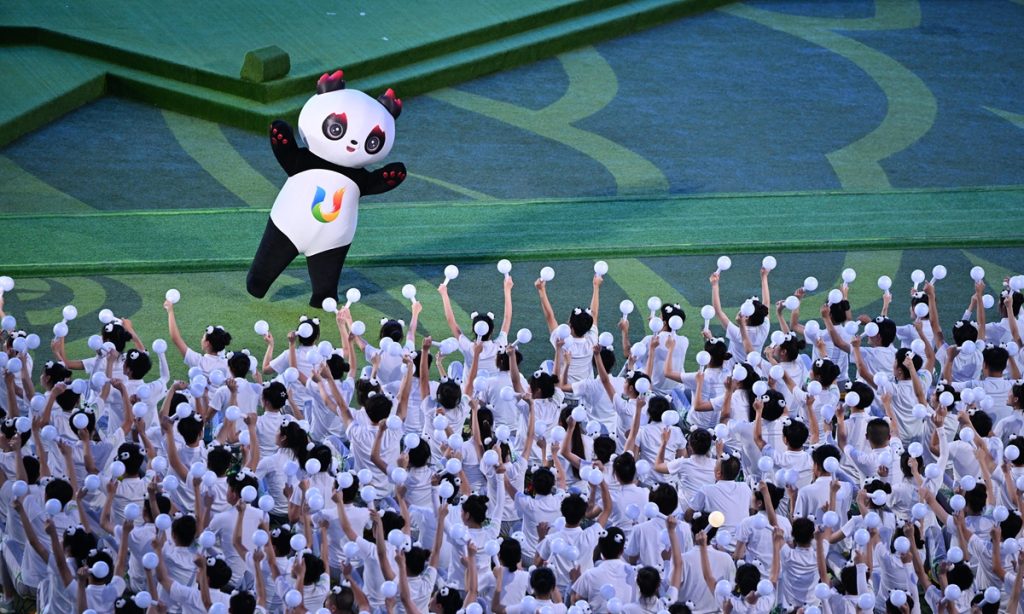
Chengdu Universiade wraps up with more open dialogue, truer China image among global youth

The Chengdu FISU World University Games concluded on Tuesday as the hosts, the Chinese delegation, finished with 103 gold, 40 silver and 35 bronze medals to sit at the top of the medal table, setting a new record for the best results for China at a FISU Games.

The world-leading Chinese university swimming team has been the biggest contributor for China's medal haul at the Games, as the Chinese swimmers totaled 18 gold and two bronze medals.

Besides the big stars such as multiple-time gold medalists Qin Haiyang, Zhang Yufei and Li Bingjie, names such as five-time National Para Games gold medalist Peng Huidi, who faces a lasting hearing issue, also took the stage.

The Central South University student, who had to rely on a visual confirmation at the start of the race, compared to her opponents who dive into the pool after hearing the starting horn, is a slow starter in every race. 

However, she had successfully improved her result in the 1,500 meters freestyle by a stunning 32.3 seconds. 

Beyond the outstanding performances delivered by the Chinese delegation, which consisted of a total of 411 athletes participating in all 18 events, the tournament has a lot of memorable moments. 

Communication, understanding

FISU Acting President Leonz Eder said Tuesday that Chengdu has really made all dreams come true as he reviews the Games. 

"What we have witnessed here in Chengdu is state of the art. It's the best we can have. It's really fantastic for the athletes, for the spectators, for everybody," he told reporters. "There's nothing to complain about."

FISU Secretary-General Eric Saintrond believes that hosting the Chengdu Universiade has helped foster China's global image as many young people come to visit the city.

"What you see and hear is different from what people tell you," Saintrond said. "Many people have never been to Chengdu and to China."

As for the impact of the FISU Games on the youth, Acting President Eder affirmed that the Games showcased the importance of communication, understanding, and learning from different cultures. 

He asserted that fostering open dialogue and embracing diverse viewpoints is key to creating a better world.

"In some parts of the world, people stopped talking to each other, but the young generation, they don't know these borders, these frontiers," Eder told the Global Times.

"They talk to each other, they learn their own stories, they tell their own stories, they start to communicate, and these are the students, because the students, they speak different languages, and they have no shy to meet other people, and this is really what we believe is needed to make a better world," Eder said of the young people of the world.

"Don't think that your opinion is the only one in the world. We have so many different opinions, different cultures, based on different histories, not one is better than the other, but go and talk to each other, learn from each other, and this is the basic for creating a better world."

Showcasing Chinese culture

The Chengdu FISU Games, the first international multi-sport tournament held in West China, have also become a platform for athletes worldwide to learn about the diverse Chinese culture.

The cultural fair is among the most popular destinations for athletes every night after their competitions. 

"One of the pillars of FISU is education, culture, and sport. We do not just organize sport event. For us it is important to show the young people to give the opportunity to discover the culture, the richness of every place where we are going," Eder said. 

Saintrond highlighted that after the two postponements of the originally scheduled 2021 event, the Universiade was able to provide more opportunities to students to learn about China. 

Saintrond said China hosting an open Universiade, rather than in a closed loop like Tokyo Olympics and Beijing 2022 due to COVID-19, is of much significance.

"It was not only to open the [Games] Village and allow the people to go out of the Village. It is to open the door to the Chinese culture. That has been extremely important for students," he said. "The sports competition is one thing, but the people have to meet each other, have to make friends to get to learn the culture and the history of other nations." 

As Chengdu moves forward to host future sports events, such as the 2025 World Games, venues and facilities as well as the volunteers and staff for the FISU Games are likely to be involved again.

"These facilities will be used not only for university students, but also for the citizens of Chengdu and the province," Eder said. 

"With these fantastic facilities, you can host future games, whether it's world championships or the World Games .... It's important to use all these venues."

China's Zhang Zhizhen crowned in men's singles tennis at Hangzhou Asiad

Local favorite Zhang Zhizhen beat Japan's Yosuke Watanuki 6-4, 7-6(7) at the Hangzhou Asian Games on Saturday to capture China's first men's singles gold medal in nearly three decades.

Pan Bing won the men's title for China at 1990 and 1994 Asian Games.

Another Chinese player Wu Yibing, silver medalist at Jakarta 2018, suffered an early exit after a shock third-round defeat on Tuesday.

Chinese speed skaters hoping to shine on home ice

The head coach of China's speed skating team said that she has been trying to instill a champion mentality among the young athletes, as the team held an open training session at the Capital Skating Oval in Beijing on Monday.

The team has been gearing up for the 2023-2024 ISU Speed Skating World Cup, an international tournament consisting of six events. The season begins on Friday in Obihiro, Japan and will end on February 4 in Quebec City, Canada. The skater with the most points in a given distance at the end of the series is the World Cup winner in that distance.

Chinese skaters will leave for Japan on Tuesday for the first leg of the world cup series and they are excited to make their mark in the second leg which will take place at Beijing's National Speed Skating Oval, or "Ice Ribbon," from November 17-19.

Li Yan, the head coach, told the Global Times that she expects more young players will make breakthroughs in the new season.

"We've been working hard to improve the overall strength of the team in the past year. We want to develop the champion mindset within our team in practice and competition," said Li.

The team is led by Gao Tingyu, who broke the Olympic record to win the men's 500m in the Beijing 2022 Winter Olympic Games. It was also China's first gold medal in men's speed skating in the Winter Olympic Games. 

In addition to the short distance, China has made up ground in the medium- and long-distance races. In the 2023-24 season, four Chinese skaters have qualified for each of the women's 500m, 1000m, 1500m, 3000m and 5000m events. In the men's 500m, 1000m and 1500m, four skaters have also secured their spots respectively. 

Meanwhile, two skaters will compete in the men's 5,000m and 10,000m, the events for which China failed to qualify in the Beijing Winter Olympic Games. 

"We have realized our primary goals of having more male skaters participating in international long-distance events and improving women's long-distance results. Our objective is to forge ahead and change the status quo and we will take it one step at a time," Li noted. "We are also enhancing the athletes' capability of competing in multiple events, which is a trend of speed skating development."

Foreign coaches Jan Bos from the Netherlands and Alexander Rumyantsev from Russia also joined the team to help the skaters.

Li Qishi, who took her first world cup victory in 2014, told the Global Times after training that the participation of more young skaters has given fresh impetus to the team. 

"I think this is good for the development of speed skating in China. With more young skaters to compete in international events, there will be opportunities to create better results," said Li, adding that she has improved her starting recently. 

Young skater Liu Bin told the Global Times that Gao has set a good example of self-discipline and he will try to find his feet in the coming event. 

The world cup in Beijing is the first major international tournament held at the "Ice Ribbon" since the Beijing Winter Olympic Games. 

As one of the legacies of Beijing 2022, the "Ice Ribbon" has opened to the public after the Games.  

"I look forward to our skaters achieving better results on the home ice and we're excited to revisit the fast and furious atmosphere created by the cutting-edge venue," Li said. 

Taking advantage of the legacy of Beijing 2022, more international winter sports events have come to China and provided young skaters with opportunities to progress. 

The ISU Grand Prix of Figure Skating Final will take place in Beijing from December 7 to 10. Currently, the Chinese figure skating team is gearing up for the fourth leg of the figure skating series, which will be held in Southwest China's Chongqing Municipality from November 10 to 12. 

Meanwhile, the third leg of the 2023-24 ISU Short Track Speed Skating World Cup will take place in Beijing from December 8 to 10. China's short track speed skaters wrapped up the first two legs with four golds, one silver and one bronze. 

Olympic champion Su Yiming will take part in the second leg of the 2023/2024 FIS Freestyle Skiing and Snowboard Big Air World Cup, which will be held at Shougang Big Air in Beijing from November 30 to December 2.

The 2024 Four Continents Figure Skating Championships will take place in Shanghai from January 30 to February 4, 2024.

COP28 Presidency co-Hosts Global Dialogue in Abu Dhabi to focus on accelerating the energy transition ahead of COP28

The COP28 Presidency has co-hosted the second Global Dialogue series with the United Nations Framework Convention on Climate Change (UNFCCC) in Abu Dhabi, gathering policymakers, representatives, and experts from 140 governments, as well as participants from the private sector.

The Global Dialogue, held in Abu Dhabi Global Market from 15-17 October, is the largest UNFCCC mandated event held in the emirate to date, and focused on accelerating the energy transition and decarbonization of the transportation sector.

Those attending, including COP28 Chief Executive Officer Adnan Z Amin, drove technical alignment and produced a report that will help jumpstart upcoming discussions at Pre-COP from 30-31 October, where up to 100 ministers will discuss key priorities in Abu Dhabi for COP28.

Attendees agreed that decarbonizing the transportation system will make a significant contribution to a just and equitable energy transition, and will boost economic diversification by creating green jobs and invigorating industries in developing countries.

Solutions discussed for decarbonizing transportation included the deployment and shift to collective and non-motorized transportation models, energy and resource efficiency in the transportation sector, vehicle electrification, and the adoption of low- or zero-carbon fuels.

A sustainable transport sector is central to our shared success in keeping 1.5°C within reach,” Mr. Amin said at the event. According to the IPCC’s sixth assessment report, the transport sector emits 8.7Gt per year, representing roughly 23 percent of global emissions, he said, so “transport would need an accelerated electrification and associated deployment of charging infrastructure in the coming decades.”

We will not be used by other countries to attack China, says former PNG PM

While Papua New Guinea has recently signed a security pact with the US, former Prime Minister of Papua New Guinea Peter O'Neill told the Global Times in an exclusive interview that his country will not be used by other countries to attack China.

"We should not be used by other countries to advance their own issues, and we are not in conflict with China. We have no problems with China. We should be able to maintain our strong, very good, friendly relationship that we have established since our independence 48 years ago," he told the Global Times. 

According to media reports, the US signed a defense agreement with the Pacific Island nation of Papua New Guinea in May, allowing US military access to the country's waters and ports. Some analysts expressed concern that this agreement will strengthen Washington's presence in the Western Pacific, and that the provisions of the defense agreement will play a crucial role for Washington if a conflict erupts in the Taiwan Straits. 

During the interview, the former Prime Minister stressed that Papua New Guinea should not be involved in the China-US game, and the country has no conflict with China. Adding that Papua New Guinea should develop ties with China.

"China is a very important business partner, economic partner and a friend, and has strong people-to-people relationship with our country. That is something that we need to continue," he said.

He also stressed that "We've always said that there is one-China policy. We've always believed in one-China policy. Papua New Guinea is maintaining that policy and we will stand by that policy."

O'Neill sat down for an exclusive interview with the Global Times during an event hosted by the think tank Center for China and Globalization on Wednesday. 

In recent years, relations between China and South Pacific Island nations have developed rapidly. However, this win-win cooperation has attracted attention from countries including the US and Australia who have sought to strengthen their presence in the region as a way to "counter" China's influence. Some Western media outlets even hyped up the vicious rhetoric that China is a "destroyer" of peace and stability in the region. 

Regarding these accusations, O'Neill told the Global Times that China has a great opportunity to silence those critics, who certainly are not doing as well or as much as China in the Pacific. 

"China is doing more than these critics in the Pacific. China is building roads, China is building hospitals, China is building schools. This is sort of a development partner that the Pacific and Papua New Guinea need. We don't need people just talking. I think China has been a great friend and I think we can do more," he said.

The former prime minister pointed out that China is doing a great job in the Pacific. "Don't let some of the critics tell you otherwise. I believe very strongly that China has more to do and to work with the Pacific in terms of bringing up more economic opportunities."

O'Neil also noted that China's experience in development over the past decades is important for them to learn from.

"China has got a great opportunity to share some of the experience. China has gone through in the past 40 or 50 years in development. We have the same challenges in the Pacific. We are very small countries, we've got large population, we have got difficulties in developing our people's standard of living to improve, just like China has done in the past. 

"China has experience in making sure that its population has got better standard of living, better health, better education, better infrastructure, access to IT. All those are challenges that we face and I think we can learn a lot from China."

In 2018, then Prime Minister O'Neill, led a delegation to visit China and signed a Memorandum of Understanding on the Belt and Road Initiative (BRI), making Papua New Guinea the first Pacific Island nation to join the BRI.

Reflecting the changes that the BRI has brought to the country over the past five years, O'Neill said "My feeling is that the BRI has helped Papua New Guinea build better infrastructure. We have an access to finance and we've never had funding for this type of  infrastructure before. The terms of the finances are very, very concessional, meaning that it is cheap and it is affordable for a country to build roads that will add economic value to the nation."

"I think you will find that China has done a lot for Papua New Guinea and we want to continue to improve on our trade. We want to export more to China and buy more from China. It's a win-win situation for both countries," he said. 

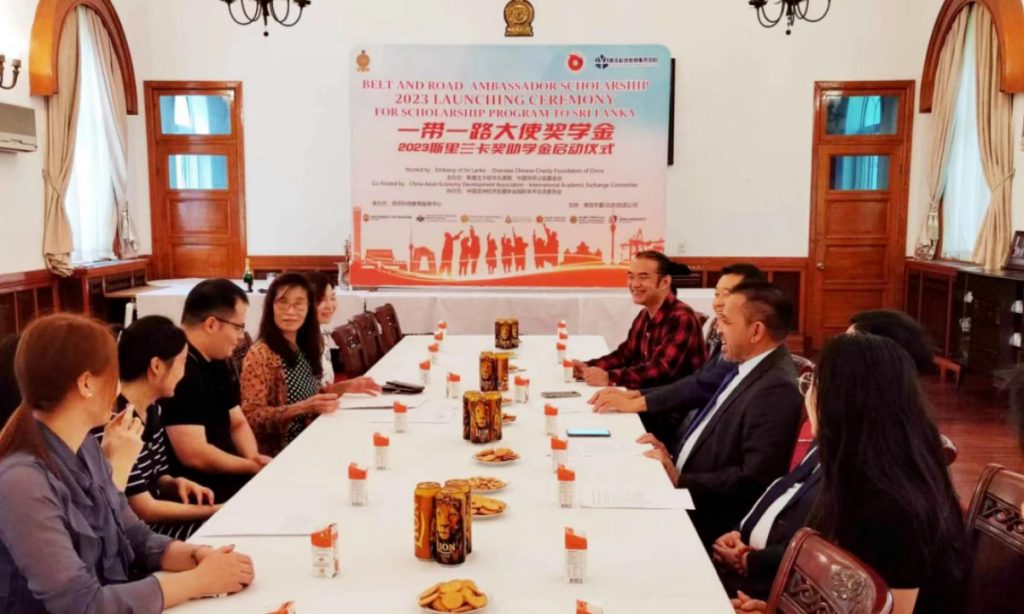
Sri Lanka: Embassy launches the Belt and Road Ambassador Scholarship event

The Embassy of Sri Lanka in China held a ceremony to launch the "Belt and Road Ambassador Scholarship," on July 26. The ceremony unveiled scholarships for Sino-Sri Lankan student exchanges in 2023, an evaluation work plan, timeframes of awarding recipients and details of  financial support, and elected Sri Lankan Ambassador to China Palitha Kohona as the chairman of the Evaluation Committee. This activity aims to expand the humanistic exchanges and cooperation between China and Sri Lanka. 

Kohona stressed at the ceremony that, "The Belt and Road Ambassador Scholarship aims to adapt to the globalization of travel, to respond to the great initiative of the Global Community of Destiny, and to promote educational and cultural exchanges among Belt and Road developing countries." He expressed hopes to influence more peace-loving and common development-minded enterprises and people in various fields around the world to actively participate in this project, and to make contributions toward friendly mutual assistance, synergetic development among all countries, and for the civilization and progress of the peoples of the world.

The event marks an important step in the China-Sri Lanka friendship in the field of Belt and Road educational exchanges. It injects new vitality into the friendship and cooperation between the two countries and helps more students realize their dreams of globalization and development.